Quality Improvement in the Department of Medicine
Clear and Conhesive 3-year Quality Improvement Work Plan (2025-2028)
Supported by the
The Department of Medicine Quality Improvement (QI) Roadmap is currently focusing on a three-year time frame (2025/6 – 2027/8) on developing the culture, expertise and measurement tools needed to achieve the highest quality of patient care. The QI Roadmap builds on the success of the DOM Innovation Platform - with 27 physician led projects supported over the last 4 years. PHC Medicine members are transforming care.

We believe Quality Improvement (QI) and Innovation are two sides of the same coin; both are integral to improving outcomes, efficiency, and patient care. Innovation brings new ideas, approaches and technologies that have the potential to transform healthcare practices. On the other hand, QI focuses on refining, optimizing, and ensuring that existing processes and practices are continually improving, delivering the best possible care to patients.
This Roadmap supports the integration of a systematic approach, guided by data, to improve the quality and safety of healthcare delivery. Quality improvement focuses on care that is safe, timely, effective, efficient, equitable and patient-centered. By leveraging QI education opportunities and integrating with existing QI resources within the organization we aim to support our members to address gaps in care.
The three-year DOM QI roadmap is anchored in developing a culture that is open to change, innovation and accountability. Our members identify problems, share ideas and develop solutions.
What is Quality Improvement?
Its a framework used to systematically improve processes and systems.
What does it aims to do?
Test a number of diffrent ideas/approaches to solve a problem specific to your local team.
Quality Improvement RoadMap

CULTURE
CAPACITY
METRICS
Will your project test different approaches to solve a problem?
Submit your idea!
2025 Department of Medicine Innovation Platform and Quality Improvement intake is now CLOSED !
Please use the following link to submit your idea: Project Submission Form - Providence Health Care
We support transformational ideas within the Department of Medicine. At the same time, the DOM recognizes the current fiscal realities. To create change we must also look at what it is we no longer need, find efficiencies, and find opportunities for cost savings.
Quality Improvement - Training opportunities and Resources
Resources
What is PQI?
The Physician Quality Improvement (PQI) program at VCH and PHC is a province wide initiative and a partnership between Vancouver Coastal Health, Providence Health Care, and the Specialist Services Committee (SSC). It is designed to address gaps in quality structures relating to physician participation in quality improvement (QI) activities. The VCH/PHC PQI initiative provides sessional funding and an opportunity for physicians from VCH and PHC, as well as those working in the community (for example, at privately owned clinics) for in-depth learning about QI theory and tools, and an opportunity to conduct their own QI project. The goal of PQI aims to enhance physician QI capability and foster a continuous learning culture within the physician community.
What do we offer?
We offer three options in your path to becoming a QI champion:
-
Level 1: IHI Open School and Video. IHI Open School offers…
-
Level 2: Intermediate Training. Sign up and attend….
-
Level 3: Advanced Cohort Training. Our flagship training…
-
QI Coaching. Book an appointment to speak with our team about QI...
-
Additional QI Funding Opportunities. An overview of PQI opportunities...

- Defining the problem and determining the best approach to solve it.
- Assembling a team, engaging stakeholders, and defining the project scope and timeline.
- Investigating the current state and developing a measurement plan.
- Creating work plans with clear deliverables.
- Designing and testing ideas for improvement.
- Implementing and sustaining changes.
- Spreading improvement.
- Promoting and facilitating the application of the Model for Improvement, PHC's QI Framework and QI tools such as the cause-effect diagram, process map, driver diagram, and 5 whys.
You must be connected to the PHC network to access this resources:
The Institute for Healthcare Improvement (IHI) is a leading, globally recognized not-for-profit health care improvement organization that has been applying evidence-based quality improvement methods to meet current and future health care challenges for more than 30 years.
IHI provides millions of people in health care with methods, tools, and resources to make care better, safer, and more equitable; convenes experts to enable knowledge sharing and peer-learning; and advises health systems and hospitals of all sizes in improving their systems and outcomes at scale.

- Standardize the IDA care at MSJ OPD - Providence Health Care
- Approach to benzodiazepine tapers
- Access to Sedation
- Delay Treatment Policy
- Status epilepticus and availability of EEG
- Diagnosis and management of Functional Neurologic Disorders

PHC Department of Medicine: Building our Expertise in Quality Improvement
Level 3 PQI projects done by PHC physicians include reducing wait times for transfusion, improving access to osteoporosis care, addressing physician burnout and preventing procedural complications in endoscope. Our physician led QI projects are impacting patient care.
Dr. Danille Murray (Neurology): Improve ICU EEG access by reducing EEF completion time to less than 4 business hours and reduce unnecessary sedated EEG by 50%.
Dr. Kristine Chapman (Neurology/Department of Medicine): Improve provider understanding and diagnosis of Functional Neurological Disorder (FND) to greater than 7/10 confidence.
Dr. Sarah Ickowicz (Addiction Medicine/ General Internal Medicine): Increase the monthly rate of community referrals for patients with substance use admitted to MSJ hospital by 30%.
Dr. Wendy Davis (Hematology): Reduce patient time spent on transfusion care
Dr. Keeva Lupton (Geriatric Medicine): Improving Geriatric Inpatient Care: Reducing Catherization Duration on the St Paul’s Hospital ACE Unit
Dr. Chipman Taylor Drury (Internal Medicine): Reducing Acute Pulmonary Embolism (PE) and Hospital Stays at St Paul’s Hospital
Dr. Santabhanu Chakrabharti (Cardiology): Promoting Physician Well Being: Addressing Burnout in St Paul’s Hospital Cardiology Division
Dr. Chipman Taylor-Drury (Internal Medicine): To reduce acute pulmonary embolism hospital admissions by 50% and length of stay by 2 days
Dr. Fergus To (Rheumatology): Enhancing Myositis Patient Care at the VCH Myositis Clinic Through Specialized Physiotherapy Assessment
Dr. Julia MacIsaac (Addiction Medicine): Improving rates of screening for sexually transmitted and blood borne infections among patients initiating care at the Rapid Access Addictions Clinic
Dr. Sabrina Gill (Endocrinology): Improve access to osteoporosis assessment and care post hip fracture
Dr. Julia MacIsaac (Addiction Medicine): To improve the accessibility and effectiveness of the Hepatitis C clinic within the Rapid Access Addictions Clinic (RAAC) at St. Paul's Hospital
Dr. Sabrina Gill (Endocrinology): To provide optimal post-fracture care and improve care for patients with fragility fracture and to prevent future fractures
Dr. Tony Wan (Internal Medicine):DVT Pathway - Turning Patient Care Upside Down
Dr. Kateryna Vostretsova (Internal Medicine): Delabelling Penicillin allergy at Richmond Hospital
Dr. Mark Fok (Geriatrics): Connecting long-term care patients with their family and friends
Dr. Jordanna Kapeluto (Endocrinology and Metabolism): Optimizing care for diabetes patients
Dr. Janet Simons (Internal Medicine): Improving the flow and efficiency of outpatient lab services
Dr. Sylvie Galindo (Internal Medicine): To implement recurring QIConference – Lion's Gate
Dr. Robert Enns (Gastroenterology): Endoscopic Complication Assessment SPH (ECAP)
Dr. Tony Wan (Internal Medicine): Development and evaluation of a management pathway for patients presenting to SPH ED with DVT and PE
Dr. Mark Fok (Geriatric): To improve the safety climate using the Hospital Survey on Patient Safety Culture (HSOPSC) post-implementation of the curriculum
Dr. Viet Vu (Physical Medicine and Rehabilitation): Increase the screening of SDB to at least 80% during SCI rehabilitation at GF Strong
Dr. Ken Kaila (Critical Care): Improve data collection of pain, agitation, delirium in Cardiac ICU
Dr. Queenie Dinh (Infectious Diseases): Improve Outpatient Parenteral Antibiotic Therapy (OPAT) attendance rates through different possible interventions
Dr. Evan Kwong (Physical Medicine and Rehabilitation): Improving access to inpatient stroke rehabilitation at Holy Family Hospital
Dr. Ruth MacRedmond (Critical Care Medicine): Improve advanced care planning through the use/adaptation of the Serious Illness Conversation Guide
Dr. Trudy Nasmith (Internal Medicine): Understanding patients who leave against medical advice
Dr. Nathaniel Hawkins (Cardiology): Spreading Heart Failure audit processes from PHC to VGH
Dr. Mypinder Sekhon (Critical Care): Identifying individual perfusion targets for patients in ICU with traumatic brain injury (TBI)
Meet our Working Group

Dr. Kristine Chapman

Dr. Anita Palepu

Theresa McElroy
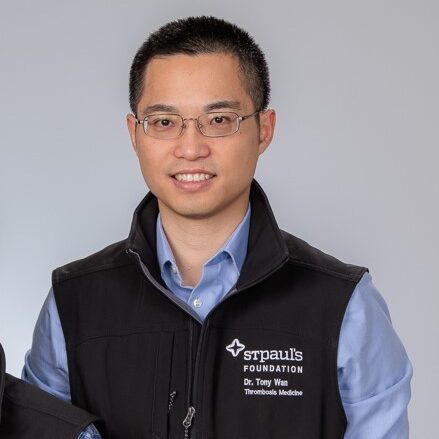
Dr. Tony Wan

David Brown